
Total Cost of Ownership for Software: The Lines Everyone Forgets
A build quote is one number in a five-year calculation. Here is what the other four years actually contain, and how to price them before you sign anything.
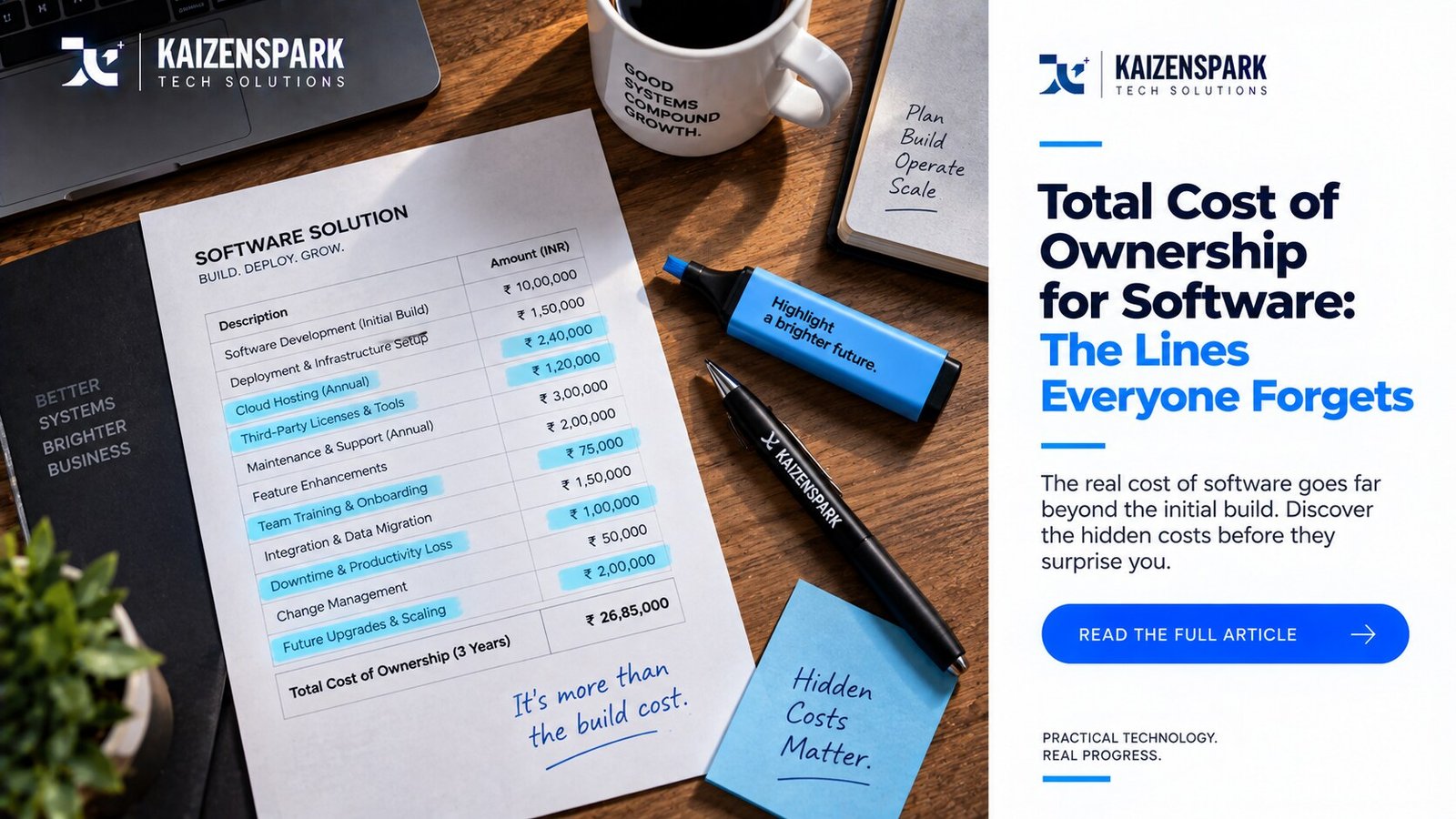
A build quote answers one question: what will it cost to launch? It rarely answers the question that determines whether the project was worth doing: what will it cost to own?
This is a companion to our guide on what custom software actually costs. That piece covers pricing the build. This one covers everything after launch day.
Why the build is the smallest number in the calculation
The US Government Accountability Office reports that of the more than $100 billion the federal government spends annually on IT and cyber-related investments, agencies have typically reported spending about 80% on operations and maintenance of existing IT rather than building anything new. (GAO-25-107795) That is a portfolio figure for an old federal estate, not a rule for your project — but it demonstrates the shape of the problem: once something exists, running it dominates the lifetime bill.
The often-repeated "60–80% of software lifetime cost is maintenance" traces to Robert Glass, writing in IEEE Software in 2001, who actually said 40 to 80 percent, 60 percent average — in an opinion column that cited no source. (IEEE Software, 2001) Treat it as an experienced practitioner's estimate, not a measured fact, and use it as a planning range rather than a precise multiplier.
The five lines a build quote usually omits
Hosting and infrastructure that scale with usage. A quote often prices hosting at launch volume. Usage grows, and the bill grows with it — sometimes faster than revenue does.
Dependency maintenance. Every library your software is built on will eventually publish a security update. Somebody has to apply it, test that nothing broke, and redeploy. This work is invisible until it's skipped, at which point it becomes a security incident.
Support. Whether it's a person, a rota, or a ticket queue, someone answers when something breaks. This cost exists whether or not it appears in your budget.
Change. The business will not stay the way it was on launch day. New regulation, a new sales channel, a merger — the software has to follow, and "the business changed" is not a valid reason for a project to have no ongoing budget.
Technical debt service. McKinsey's 2020 survey of 50 CIOs at financial services and technology firms above $1 billion in revenue estimated technical debt at 20–40% of the value of the entire technology estate before depreciation, with 10–20% of new-product budget diverted to servicing it. Small sample, self-estimated, two sectors — but the direction matches what developers report themselves: in Stack Overflow's 2024 survey, technical debt was named the top workplace frustration by 62.4% of the 28,251 professional developers who answered that question. (McKinsey, Stack Overflow)
The line nobody prices at all: leaving
The UK Competition and Markets Authority investigated cloud services for nearly two years and found that less than 1% of customers switch provider each year, naming egress fees as a key commercial barrier and finding that technical and commercial barriers together "lock customers into their initial choice of provider." (CMA, July 2025)
This is changing, but only in the EU: Article 29 of the EU Data Act prohibits cloud switching charges entirely from 12 January 2027. (Regulation (EU) 2023/2854) Everywhere else, exit cost remains a real and unpriced line.
Building the model
A usable five-year TCO model has, at minimum: build cost (year one), hosting scaled to a realistic usage growth curve, a maintenance line at 40–80% of the original build cost annually as a planning range, one major change project every 18–24 months, and an exit cost estimated from what the vendor tells you it takes to leave — before you sign, not after.
If the five-year number is uncomfortable, that discomfort is information. It is cheaper to feel it now than to discover it in year three.
Kaizen Spark Tech designs and delivers software, AI, automation and digital infrastructure for businesses and institutions. Every statistic here is linked to its original published source.