Red Flags in a Software Development Proposal
Most bad vendor relationships were visible in the proposal, before anyone signed anything. Here is what to look for while you still have the leverage to walk away.
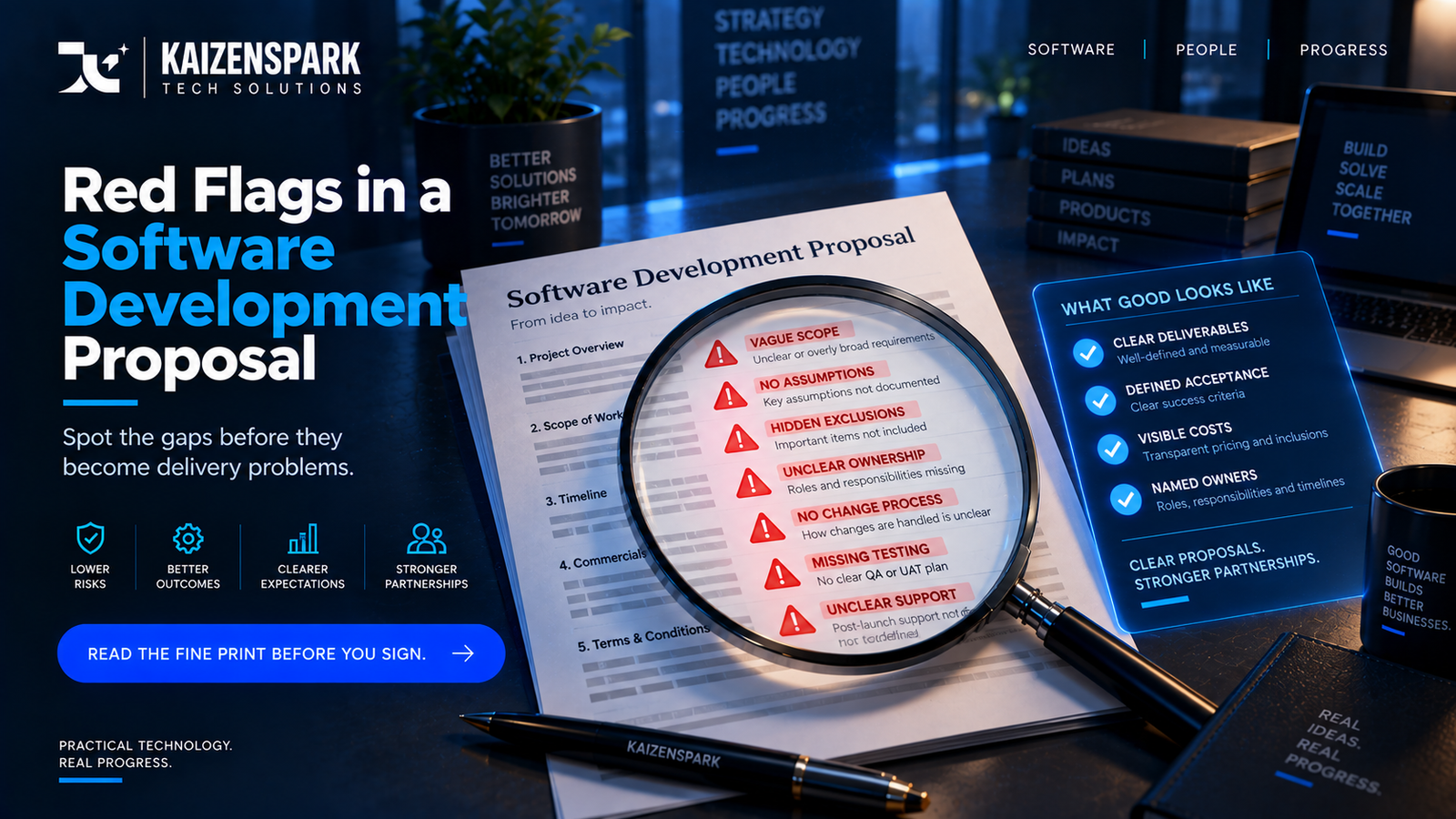
By the time a project is visibly troubled, the warning signs were usually sitting in the proposal the whole time. This is a companion piece to our guide on choosing a software development partner and our list of twelve questions to ask before signing. Here we focus on what to actually look for on the page.
Scope and pricing red flags
A single number with no visible workings. Team composition, seniority mix, duration, rate — if none of these are stated, you cannot challenge the number, and a vendor confident in their reasoning would have shown it.
No quality assurance line. QA analysts earn a mean of $111,490 annually in US labour data, meaningfully less than developers but not nothing. (BLS) A proposal with no QA line has not made the project cheaper. It has moved the testing into production, where your users perform it.
A quote dramatically below the others, with a vague scope. As covered in why the cheapest quote is usually the most expensive, a low number is frequently a scope statement, not a discount — the gap reappears later as a change request, when you have less leverage.
No mention of the running cost. If the proposal prices only the build and says nothing about hosting, maintenance, dependency updates and support, you are looking at a deposit, not a total.
Certainty and process red flags
Certainty about your requirements in the first meeting. Anyone who fully understands your problem before investigating it is pattern-matching to something they have already built, which may or may not be your actual problem.
No failure story. Ask which of their projects didn't work, and what happened. Anyone who has delivered at scale has an answer. A proposal or pitch that implies a flawless track record is either inexperienced or not being candid — both worth knowing before you sign.
A discovery phase sold with the "100x cheaper to fix early" claim. This figure traces back to an internal IBM training programme that published no dataset. The largest modern study — 171 projects between 2006 and 2014 — found "no evidence for the delayed issue effect." (Empirical Software Engineering, 2017) Discovery is genuinely worth doing for other reasons; a proposal selling it with this specific claim is selling folklore.
Commercial pressure red flags
Discounts that expire on a deadline. A meaningful price reduction that vanishes if you don't sign this week is a sales technique, not a reflection of genuine cost structure.
Reluctance to discuss the exit. Ask what it costs to leave — code ownership, repository access, documentation quality, transition support. The UK Competition and Markets Authority found that in cloud services, less than 1% of customers switch provider each year, with barriers that "lock customers into their initial choice of provider." (CMA, July 2025) A vendor who hesitates on this question has told you something about how the relationship will feel once you want out.
A loose scope paired with a very precise change-request process. This is a recognised commercial pattern — quote low, win the work, recover margin through changes — and the tell is a contract where ambiguity and precision are distributed exactly backwards from where you'd want them.
AI-specific red flags, current as of 2026
Claims about "agentic AI" capability that don't survive a follow-up question. Gartner has named the practice of rebranding existing chatbots and automation scripts as "agents" — sometimes called agent washing — and estimates only a small fraction of vendors claiming the capability are offering something genuinely new. (Gartner) Ask what the system does when it is uncertain. A real agent architecture has a specific answer.
What a proposal without red flags looks like
It states its assumptions rather than hiding them. It prices the whole lifecycle, not just the build. It answers the failure question directly. And it treats questions about the exit as reasonable business due diligence rather than an insult.
What we do
We would want our own proposals held to exactly this list. If you are reviewing a proposal and want a second opinion before you sign, that is a conversation we are glad to have — including about proposals that are not ours.
Kaizen Spark Tech designs and delivers software, AI, automation and digital infrastructure for businesses and institutions. Every statistic here is linked to its original published source.