
12 Questions to Ask Before You Sign a Development Contract
Most of what determines whether a software contract goes well is decided before anyone writes a line of code. These are the questions that actually predict it.
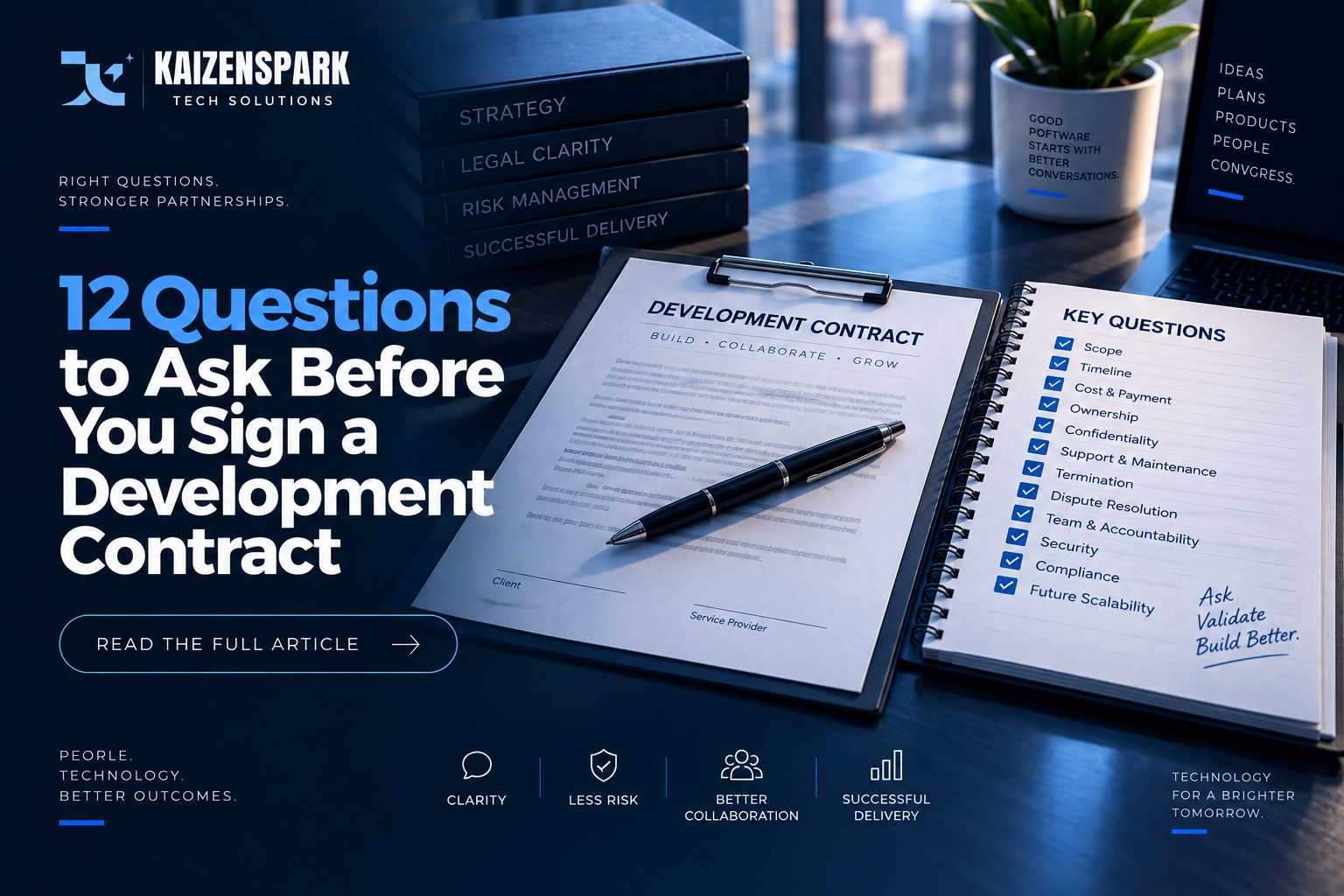
Most of what determines whether a software project goes well is decided before anyone writes a line of code — in the contract, and in the conversation that produces it. This is a companion piece to our guide on choosing a software development partner. Here we get specific: the actual questions, in the order that matters.
On scope and price
1. What exactly does this quote assume? Team composition, seniority mix, duration, loaded rate. A number with no workings is a position, not an estimate, as we cover in why the cheapest quote is usually the most expensive.
2. What is explicitly excluded? Not "what's included" — every vendor answers that well. Ask what a reasonable client might expect that this quote does not cover.
3. What would make this cost three times more, and what catches it early? The largest peer-reviewed study of IT project costs — 5,392 projects collected, 4,677 with usable cost data — found a median overrun ratio of 1.0 but a mean of 1.8, driven by a long tail with no statistically significant relationship to project size (p = 0.863). A vendor who has internalised this will answer specifically. One who says "we have a rigorous process" has not answered. (JMIS, 2022)
On delivery and quality
4. Who will actually do the work, by name? The most common bait-and-switch in this industry is the senior team that wins the pitch and the junior team that delivers. Ask for names, seniority mix, and time commitment, and put it in the contract.
5. Is there a dedicated quality assurance line, and who does it? QA analysts earn a mean of $111,490 annually in US labour data — cheaper than developers, not free. (BLS) A proposal without a QA line is not a cheaper proposal. It is an incomplete one.
6. What does the discovery phase actually produce? A discovery phase should end with a written, specific artefact — not a vague sense that both sides understand each other better. Ask to see an example from a previous project.
On the relationship after signing
7. Which of your projects didn't work, and what happened? The single most informative question available. Anyone who has delivered at scale has an answer. Watch for the version where the client was entirely at fault — that is blame-shifting with better staging, not candour.
8. How is progress actually reported, and by whom? Vague status updates are how scope drift and cost overruns stay invisible until they are large. Ask for a sample status report from a comparable project.
9. What happens if a key person leaves mid-project? Concentration risk in personnel is rarely discussed until it becomes a crisis. Ask for the contingency in writing.
On the exit
10. What does it cost us to replace you? The UK Competition and Markets Authority found that in cloud services, less than 1% of customers switch provider each year, with technical and commercial barriers that "lock customers into their initial choice of provider." (CMA, July 2025) The same dynamic applies to development relationships. Ask specifically: who owns the code, where do the repositories live, is the documentation good enough for a stranger to pick up, and is transition support priced.
11. Who owns the intellectual property, in what format, and when does ownership transfer? Get the answer in writing before signing, not as a negotiation point after a dispute begins.
12. What is the running cost after launch, and is it in this quote? If year one is the only year priced, the quote is a deposit, not a total. Hosting, dependency maintenance, support and the change the business will inevitably need all belong in the number you are comparing against other quotes.
What a good answer sounds like across all twelve
Specific, immediate, and slightly uncomfortable for the vendor to give. A vendor who answers question 7 with a real failure and a real lesson, prices question 12 honestly even though it makes their total number look bigger, and treats question 10 as reasonable rather than insulting, is telling you something true about how they will behave once the contract is signed and your leverage has shrunk.
What we do
We would want all twelve asked of us, and we answer them the same way for every prospective client, before any commercial conversation narrows the incentive to be candid. If you are working through a shortlist and want a second opinion on the answers you are getting, that is a conversation we are glad to have — including about vendors that are not us.
Kaizen Spark Tech designs and delivers software, AI, automation and digital infrastructure for businesses and institutions. Every statistic here is linked to its original published source.