
Integration Debt: The Cost of Every Tool You Add
Every tool in your stack has to talk to the others, and each connection needs maintaining as both ends change independently. A decision that looks cheap in isolation — one more tool — can be expensive in aggregate, and almost nobody counts the aggregate.
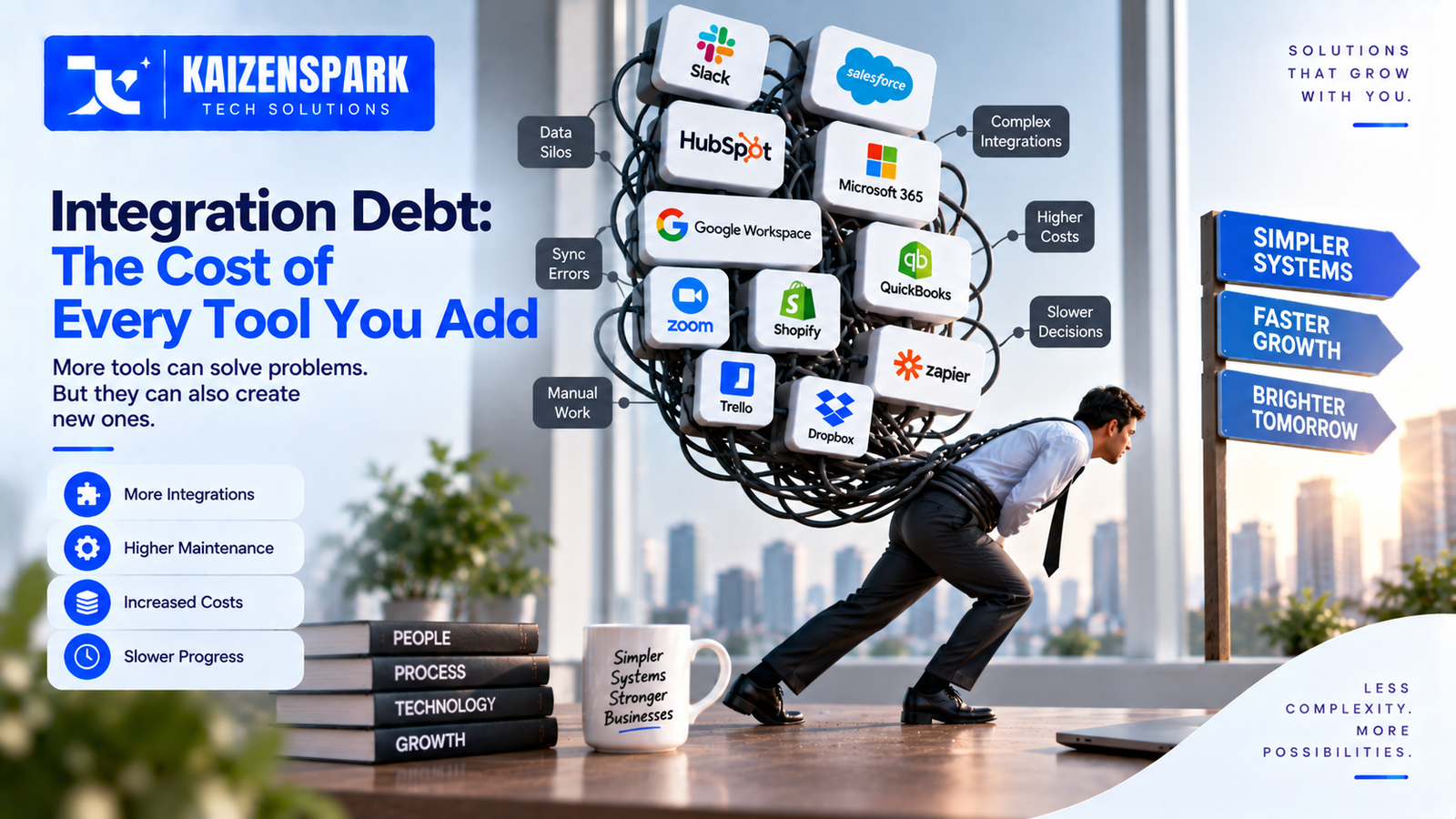
Every new tool added to a technology stack is evaluated on its own merits — what it costs, what it does, whether it solves the problem in front of you. Almost nobody evaluates what it costs to keep that tool talking to everything else in the stack, indefinitely, as every other tool also changes over time. This is a companion piece to our build vs buy framework.
What integration debt actually is
Integration debt is the accumulating cost of maintaining the connections between systems, as distinct from the cost of the systems themselves. A stack of five tools that each need to exchange data with two others has a meaningfully larger integration surface than a stack of three tools with the same relationships — the number of connections grows faster than the number of tools, and each connection is a place where things can silently break.
This is the same underlying dynamic covered in our piece on why the cheapest quote is usually the most expensive applied to architecture rather than procurement: the visible cost (the tool's licence fee) is not the total cost, and the invisible cost (ongoing integration maintenance) accumulates regardless of whether anyone is tracking it.
Why this compounds specifically
Each integration has two independently changing endpoints. When either system updates its API, data model, or authentication method, the integration between them can break — and neither system's own release notes typically account for the downstream effect on everything integrated with it. You are maintaining a connection whose stability depends on decisions made by two separate vendors who do not coordinate with each other or with you.
Integrations are typically built once and then neglected. The initial integration gets proper attention during implementation. Ongoing maintenance of that integration — testing it against each endpoint's updates, monitoring for silent failures — competes for the same limited engineering capacity as every other maintenance task, and it is easy to defer because a quietly failing integration (data not syncing, a field silently going empty) is less immediately visible than a system that is fully down.
The organisational knowledge of how integrations work concentrates in very few people. Unlike a core product a whole team works in daily, an integration between two specific tools is often understood by whoever built it and nobody else — a specific, high-risk case of the institutional knowledge concentration risk covered in our piece on auditing a technology estate.
Why it is undercounted in build vs buy decisions
Our main build vs buy framework makes this point directly: count the integrations before you count the licences. A decision to buy five separate best-of-breed tools, each individually cheaper and better at its specific function than an integrated alternative, can be more expensive in aggregate than a single, less specialised platform — once the integration maintenance cost between all five is counted honestly.
This does not mean best-of-breed is wrong. It means the comparison needs to include integration cost explicitly, not silently assume it away because each individual tool's price tag looked reasonable.
What reduces integration debt
Count the number of integrations, not just the number of tools, before adding to the stack. A new tool that needs to connect to three existing systems adds three new points of potential failure, not one new line item.
Favour tools with well-maintained, standard integration methods over custom-built connections wherever possible. A standard, actively maintained integration (through a platform's own supported connector, for instance) carries materially lower ongoing maintenance risk than a bespoke integration built and maintained entirely in-house.
Monitor integrations actively, not just the systems they connect. A monitoring approach that only checks whether each system is up, without checking whether data is actually flowing correctly between them, will miss the specific failure mode — a silently broken integration — that is most common and most damaging.
Periodically audit the stack for redundant or low-value tools, specifically weighing their integration cost against their value. A tool that seemed clearly worth adding in isolation may not be worth its ongoing integration burden once that burden is counted honestly — this is a genuine candidate for consolidation, not just cost-cutting for its own sake.
What we do
We map the integration surface explicitly when advising on a technology stack, and we weigh a new tool's integration cost as part of the decision to add it, not as an afterthought discovered during implementation. If you are evaluating your stack, or considering adding a new tool, and want the integration cost counted honestly, that is a conversation we are glad to have.
Kaizen Spark Tech designs and delivers software, AI, automation and digital infrastructure for businesses and institutions.