
In-House Team, Agency, or Offshore: An Honest Comparison
The systematic evidence says the choice between building a team, hiring an agency, or going offshore matters less than how the relationship is governed. But each option still carries a different, predictable set of trade-offs worth naming honestly.
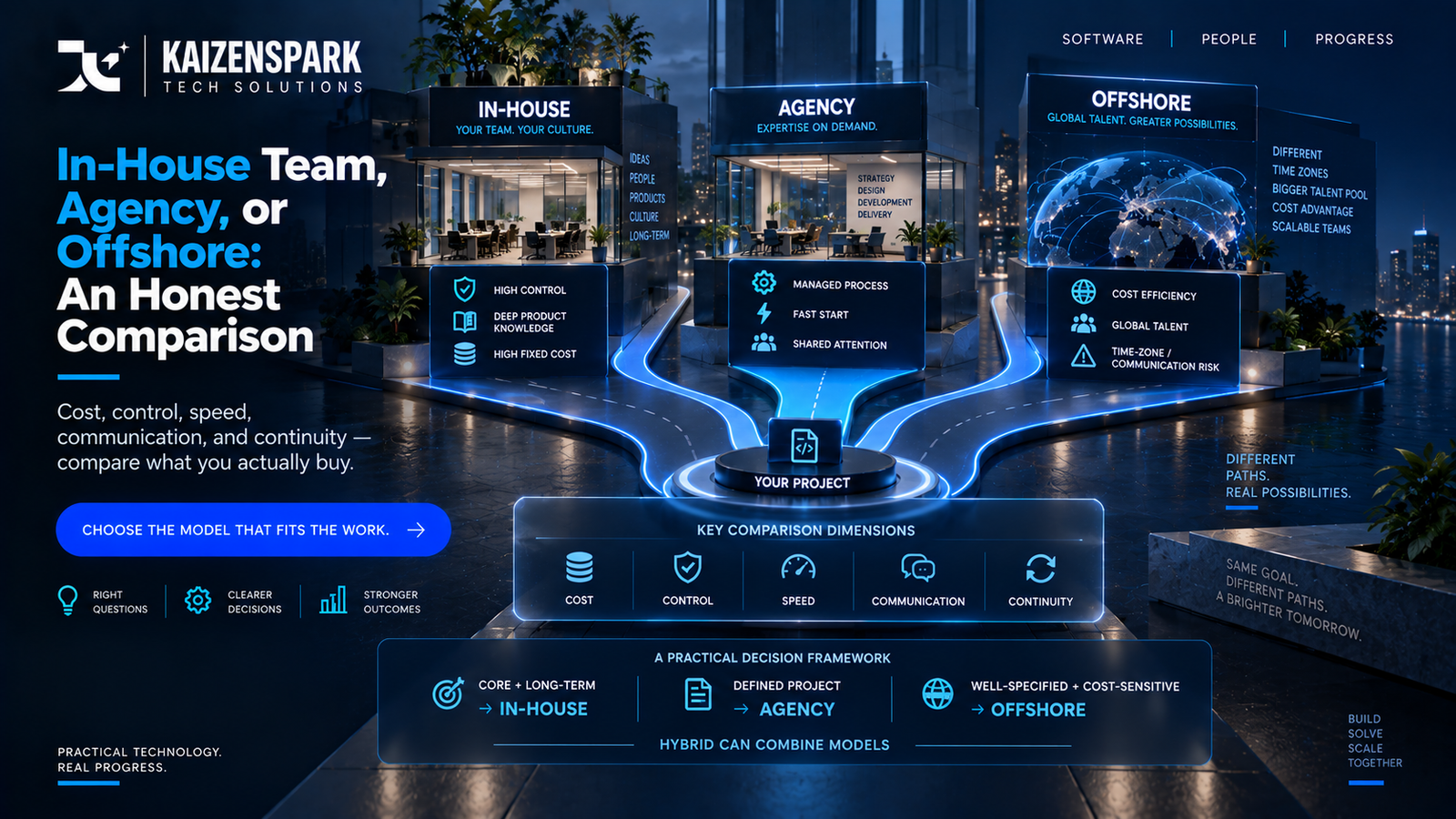
This decision gets treated as ideological — in-house is "real" ownership, offshore is "cheap," agencies are "flexible" — when the actual evidence says something more specific and less tidy. This is a companion piece to our guide on choosing a software development partner.
What the systematic evidence actually says
The most rigorous available research on sourcing decisions found that selective outsourcing outperformed both total outsourcing and total insourcing on achieving expected cost savings, in a study of 61 sourcing decisions across 40 US and UK organisations drawing on 145 participants. The same study found decisions made jointly by senior executives and IT managers outperformed unilateral decisions by either group alone. (Lacity & Willcocks, MIS Quarterly, 1998)
A broader systematic review of 164 empirical articles across 50 journals, coding 741 tested relationships, reached a sobering conclusion for anyone wanting a formula: outcomes depend far more on how the relationship is governed than on which structural category — in-house, agency, offshore — was chosen. (Journal of Information Technology, 2010)
Read plainly: the label on the arrangement predicts less than most planning conversations assume. Governance predicts more.
What each option genuinely costs, beyond the obvious
In-house. The visible cost is salary plus benefits — in the US, BLS data puts the fully loaded multiplier at roughly 1.43× wages based on private-sector compensation data, though this excludes office space, equipment, recruiting and non-billable time, so treat it as a floor. (BLS ECEC) The less visible cost is opportunity: hiring takes months, and a team built for one project does not disappear when the project ends — it needs a pipeline of future work or it becomes an idle cost.
Agency. The visible cost is the quoted rate. The less visible cost is exactly what our piece on the twelve questions to ask is designed to surface — scope ambiguity, unpriced running costs, and switching costs that only become apparent when you try to leave.
Offshore. The visible cost is the lowest headline rate of the three, and it is real: outsourcing brokerage Accelerance reports senior developer rates of roughly $31–41 per hour in Asia against $64–76 across Europe — though this is self-reported vendor pricing, not independent measurement. The less visible costs are communication overhead across time zones, and the specific finding from Project NANDA's 2025 study that externally built AI tools reached deployment at roughly double the rate of internally built ones — directionally consistent with the outsourcing literature, though the study is a preliminary working paper with a 52-organisation sample and self-reported figures, and its authors sell AI infrastructure.
The AI coding shift changes one input, not the decision
McKinsey's State of AI in 2026 found 32% of organisations have now declined to purchase software because they could build the functionality in-house using agentic coding tools, rising to nearly half among AI high performers. (McKinsey) This lowers the cost of building, which shifts the in-house option's economics — but it does not touch the governance finding above, and it does not reduce the ongoing burden of owning and maintaining what gets built, covered in our build vs buy framework.
A more useful framework than the label
Instead of starting from "in-house vs agency vs offshore," start from what the evidence actually says predicts success:
Is the decision joint, or unilateral? A decision made by IT alone, or by the business alone, tends to underperform one made jointly.
Is the sourcing selective, or total? Total outsourcing and total insourcing both underperformed a mixed, selective approach in the Lacity and Willcocks data. Most organisations do not need to pick one model for everything.
Is the relationship governed after signing, or only at signing? The systematic review's central finding — governance predicts more than structural category — means the ongoing management of the relationship matters more than which box you ticked at the start.
What we do
We are, structurally, an "agency" by the taxonomy above, so we have an obvious interest in this question. What we would tell a friend regardless: pick the structure that fits the specific work, govern it jointly and continuously, and do not expect the label on the arrangement to do the work that active management actually does.
If you are weighing this decision for a specific project, that is a conversation we are glad to have.
Kaizen Spark Tech designs and delivers software, AI, automation and digital infrastructure for businesses and institutions. Every statistic here is linked to its original published source, with sample size and limitations stated where they matter.