
Digital Transformation: Why Most Fail and What the Survivors Do
The claim that '70% of digital transformations fail' is repeated constantly and traceable to no credible primary source. The real evidence points somewhere more specific and more fixable: most transformation budgets go entirely to technology, and almost none to redesigning how people actually work.
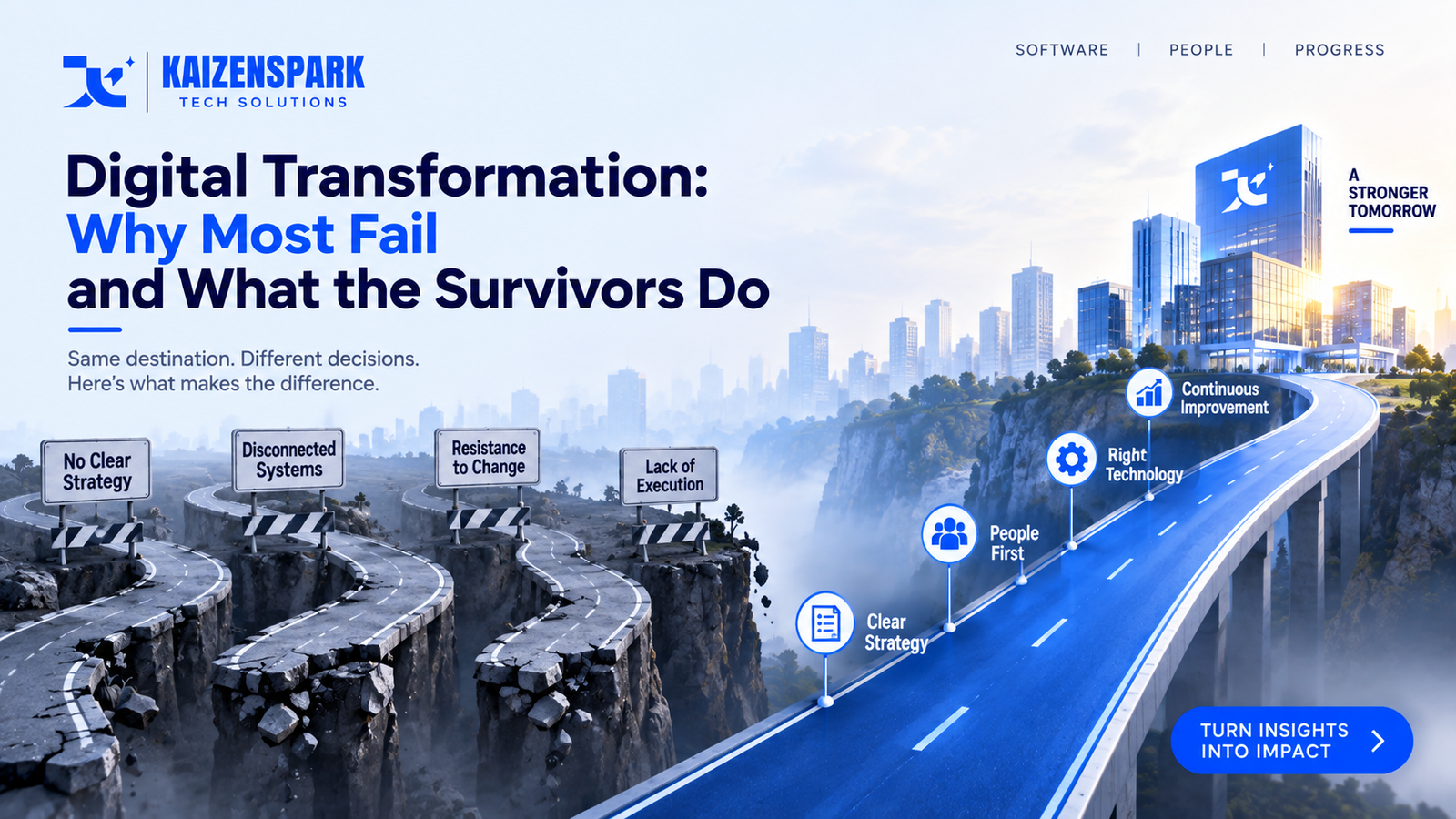
You have almost certainly seen the claim that 70% of digital transformations fail. It gets attributed vaguely to McKinsey, repeated in countless decks and articles, and traced back to no single, checkable, primary source with a clear methodology. Treat it as industry folklore rather than a citable fact — which does not mean transformation initiatives are easy or usually smooth. It means the real evidence points somewhere more specific and more useful than a single scary percentage.
What the credible evidence actually shows
McKinsey's own State of AI research found a striking, specific gap: in organisations reporting the strongest bottom-line impact from AI, 55% had redesigned their workflows to take advantage of the new capability, compared with only 20% among organisations reporting weaker impact — a roughly 2.8-times gap. (McKinsey) That is a precise, specific, checkable finding, and it points at something the "70% fail" folklore never specifies: the technology itself is rarely the differentiator. Whether the surrounding work — process, roles, incentives — was actually redesigned is.
This finding recurs across our own research: our piece on why pilots succeed and rollouts fail covers McKinsey's earlier manufacturing research on the same underlying pattern, and our piece on workflow redesign goes deeper into what redesign actually involves.
Why the technology-only approach fails predictably
Buying a new system and layering it onto an unchanged process produces, at best, the same process with a different interface. The value transformation initiatives promise almost always comes from doing the underlying work differently — fewer handoffs, different decision rights, new roles — not from a faster version of the same steps. A tool cannot supply that redesign on its own; someone has to actually do it, and it is frequently the first thing cut from scope when a project runs over budget or behind schedule.
What the survivors actually do
They redesign the workflow, not just adopt the tool. The McKinsey finding above is the clearest available evidence for this, and it is echoed in our research on AI pilots that survive contact with production: the pilots that scale successfully are the ones built around a redesigned process from the start, not a tool bolted onto the old one.
They measure outcomes, not activity. Adoption rate and login counts are activity metrics. Whether the underlying business outcome — cycle time, error rate, cost per transaction — actually moved is the outcome metric, and it is the one that determines whether the investment was worth it. We cover how to build this measurement properly in a dedicated piece.
They manage the change deliberately, rather than assuming it will happen on its own. Technology rollouts fail as often from unmanaged human resistance and confusion as from any technical defect. Our piece on change management covers what a deliberate approach looks like, and where the popular change-management frameworks come from and what evidence actually supports them.
They size the ambition to the organisation's actual capacity. A transformation programme scoped for a large enterprise's change-management resources, deployed at a mid-sized organisation's actual capacity, is set up to disappoint regardless of the technology's merit. We cover this specifically in our piece on digital transformation for mid-sized businesses on a real budget.
Why the folklore statistic persists despite lacking a source
A dramatic, unattributed statistic is more shareable than a specific, sourced, less dramatic finding, and "most transformations fail" flatters everyone who has watched one struggle without requiring anyone to specify why. The McKinsey workflow-redesign finding is less viral and more useful — it tells you exactly what differentiates the successful quarter from the rest, rather than inviting resignation about the whole category of effort.
What we do
We scope every transformation engagement to include the workflow redesign work explicitly, priced and planned rather than assumed to happen informally alongside the technology delivery. If you are planning a transformation initiative and want the redesign work built into the plan from day one, that is a conversation we are glad to have.
Kaizen Spark Tech designs and delivers software, AI, automation and digital infrastructure for businesses and institutions. Every statistic here is linked to its original published source. Where a widely-quoted figure turned out to have no traceable primary source, we have said so rather than repeated it.