
Customer Service Automation: What the Peer-Reviewed Data Shows
One study anchors almost everything credible we know about AI in customer service: 5,179 agents, a 14% average gain, and 34% for the newest staff. Here is what it found, and what remains genuinely unknown.
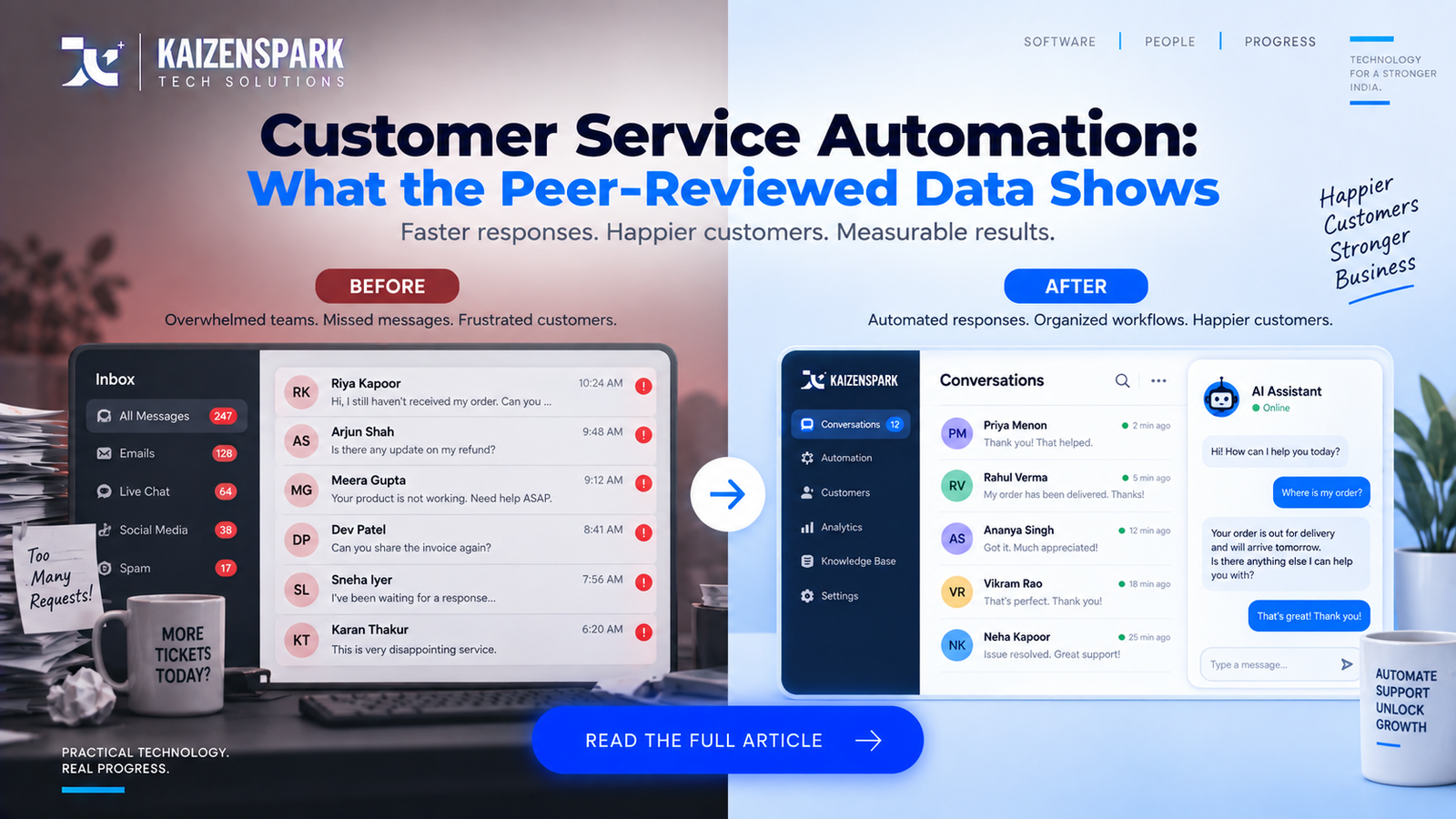
Almost every confident claim about AI in customer service traces back, eventually, to one study. That is worth knowing before you read the next vendor deck.
The study
Brynjolfsson, Li and Raymond tracked a staggered rollout of a generative AI assistant across 5,179 customer support agents at a real company. The results, published in the Quarterly Journal of Economics in 2025: access to the assistant increased issues resolved per hour by 14% on average, and by 34% for novice and lower-skilled workers, with minimal effect on the most experienced staff. Customer sentiment improved. Employee retention improved. (NBER Working Paper 31161; published version, QJE 2025)
This is genuinely strong evidence: a large sample, a real company, a staggered rollout that allows causal comparison rather than a self-reported survey, and peer review in a top economics journal.
It is also, as far as we could establish, the only evidence of this quality that exists for this specific question. We looked for independent replication at comparable scale and did not find it. Everything else circulating — the "27% average handle time reduction," the vendor claims of "$80 billion in labour cost reduction by 2026" — traces to industry blogs and AI vendor marketing pages with no disclosed sample or methodology. We are not going to cite them as corroboration, because they are not corroboration. They are marketing that happens to point in the same direction.
What the study actually tells you
The most useful finding is not the 14% average — it's the 34%-for-novices detail. The tool did not make everyone better by the same amount. It compressed the gap between a new hire and an experienced agent, functioning less like a productivity multiplier and more like an accelerated onboarding tool.
That has a direct implication for where AI customer service investment pays off fastest: teams with high turnover and long ramp times, where a large share of staff are perpetually in their first six months, stand to gain more than a stable team of veterans.
What the market is actually doing with this
Gartner's most recent customer service survey — 199 service and support leaders, fielded April to May 2026 — found that AI spending by these leaders rose 38%, while overall service and support budgets rose just 2%. Leaders are, in Gartner's framing, redirecting spend away from labour and overhead toward technology. Gartner's own caution in the same release: "hype alone doesn't make a technology the right solution to real business problems." (Gartner, August 2026)
The honest counterpoint
Not every signal points the same direction. Reporting on AI augmentation in knowledge work has raised a genuine concern worth naming even though we could not independently verify a specific primary study behind it in this piece: AI assistance can intensify work rather than simply reducing it — people using AI tools sometimes work faster and take on a broader scope, with implications for burnout in high-volume roles like customer support. We flag this as a real and plausible risk rather than a proven finding, precisely because we would criticise a vendor for citing something this loosely.
What this means for a deployment decision
The rigorous evidence supports AI assistance as a genuine productivity gain in customer support, concentrated most heavily among newer and less experienced staff. It does not yet support most of the specific percentage claims a vendor will put in front of you, because those claims mostly don't have a named study behind them. Ask for the source. If the answer is "internal data" or nothing at all, you are being sold conviction, not evidence — which may still be worth buying, but you should know which one you're getting.
Kaizen Spark Tech designs and delivers software, AI, automation and digital infrastructure for businesses and institutions. Every statistic here is linked to its original published source.