AI Agents vs RPA vs Chatbots: What the Difference Actually Costs You
Every ROI comparison you'll find between AI agents and RPA was commissioned by a vendor selling one of them. Here is what's actually known, and what isn't.
We went looking for a rigorous, independent, head-to-head comparison of cost and ROI across AI agents, RPA and chatbots. We did not find one.
What exists instead is a set of vendor-commissioned studies, each concluding that the category the sponsor sells outperforms the others. Forrester's "Total Economic Impact" studies — a real methodology, but one built from a handful of a vendor's own reference customers into a single "composite" case — exist for Sprinklr (210% ROI), Writer (333%), GitLab (400%), boost.ai (293%) and Microsoft (124–200%+). Every one of these was commissioned by the vendor being studied. None is independent research, and none should be read as one.
So this post does what evidence allows: a plain description of what each category actually is, where each genuinely fits, and rough — explicitly rough — cost and timeline ranges drawn from industry consensus rather than a single disputed study.
What each one is
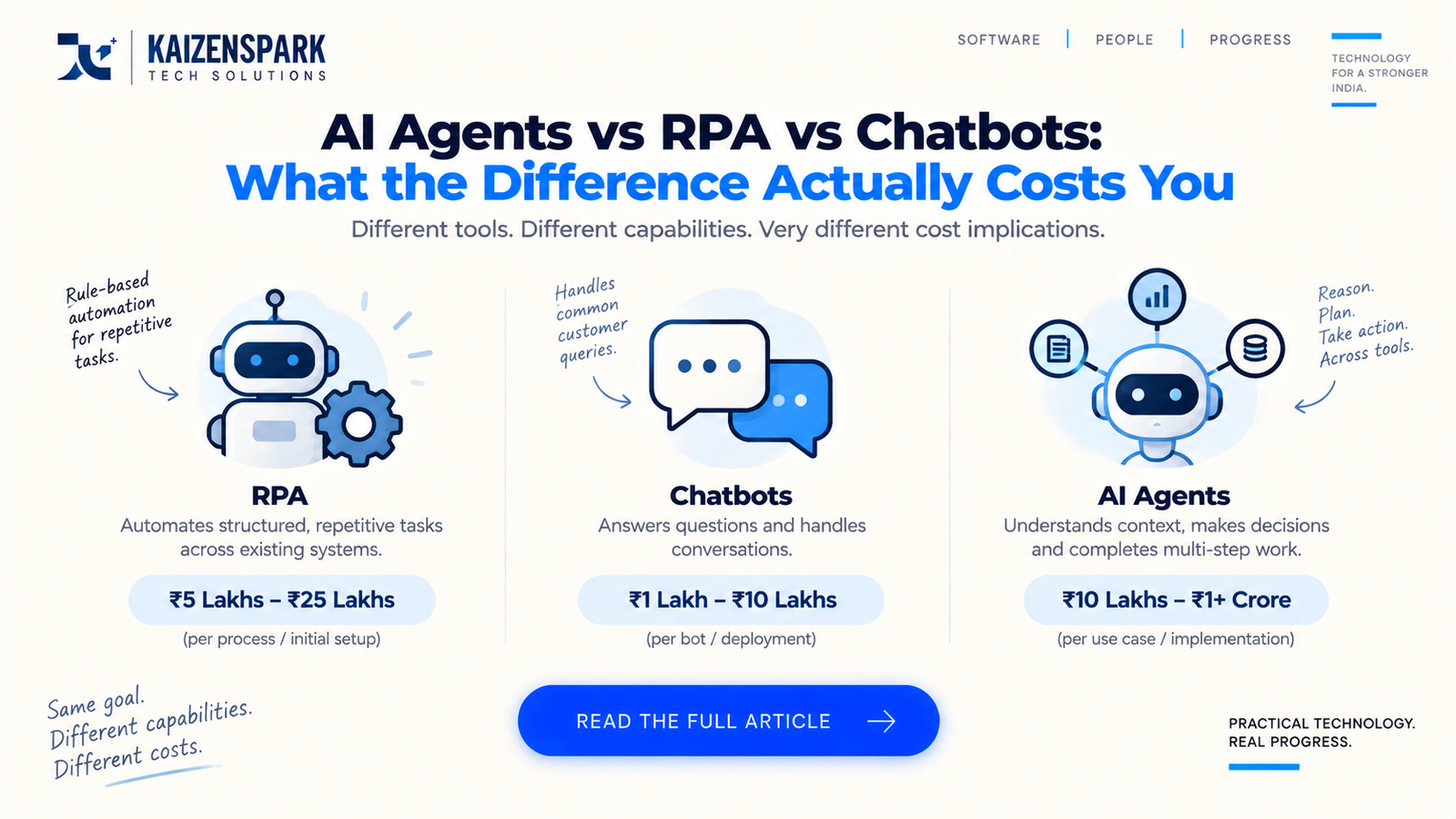
Chatbots answer one turn at a time. Fast to build, cheap to run, limited to conversation.
RPA executes a fixed script against a stable, well-defined process: extract this field, click here, paste there. It is deterministic — the same input always produces the same output — which makes it reliable and auditable, and brittle the moment the input changes shape.
AI agents plan across multiple steps, choose which tools to use, and adapt when something doesn't go as expected. (NIST)
Rough cost and timeline ranges
Industry consensus, not a single rigorous study, puts typical implementation timelines at roughly 2–8 weeks for a chatbot, 1–4 months for RPA, and 3–6 months for an AI agent, depending on complexity and how much of the surrounding process needs to change to accommodate it. Treat these as directional, not precise — no disclosed-methodology study underlies them, and this post will not pretend otherwise by attaching a false decimal point.
Specific dollar comparisons circulating online — "$228,000 for RPA versus $77,000 for AI agents," "8:1 ROI for agents versus 2:1 for RPA," "40% TCO reduction within 24 months" — all trace to AI-agent vendors marketing against RPA, with no disclosed sample or methodology behind any of them. They are not citable, and a vendor who repeats them to you as fact has told you something about how carefully they check their own claims.
Where each genuinely fits
Use a chatbot for high-volume, low-complexity conversational tasks where a single good answer resolves the interaction: FAQ handling, simple status lookups, first-line triage before escalation.
Use RPA where the process is genuinely stable and well-documented, the inputs rarely change shape, and auditability matters more than adaptability — reconciliation, data entry between systems that don't talk to each other, repetitive form processing.
Use an AI agent where the task requires judgement across multiple steps, the inputs vary in ways that would break a fixed script, and the cost of occasional error is tolerable against the cost of building for every edge case in advance.
The costly mistake in both directions is well documented even without a formal ROI study: buying agent-grade complexity and price for an RPA-shaped problem, and buying brittle RPA for a problem that genuinely needs judgement. Gartner's warning about "agent washing" — vendors rebranding RPA and chatbots as agents — exists precisely because the first mistake is so profitable for the vendor making it easy to make. (Gartner, June 2025)
The question that cuts through vendor comparisons
Don't ask a vendor to compare their category favourably to the others. Ask them to describe the shape of your actual problem, and let them tell you honestly which category — including one they don't sell — fits it. A vendor willing to tell you that RPA is the right, cheaper answer to your problem is more trustworthy than one who has an agent for everything.
Kaizen Spark Tech designs and delivers software, AI, automation and digital infrastructure for businesses and institutions. Every statistic here is linked to its original published source, and where no credible source existed for a widely-repeated claim, we have said so rather than repeated it.