
AI Agents for Business Operations: A Practical Guide
Nine in ten companies say they use AI. Gartner estimates only about 130 of the thousands of vendors selling 'agents' have built anything that deserves the name. This is the guide to telling the difference.
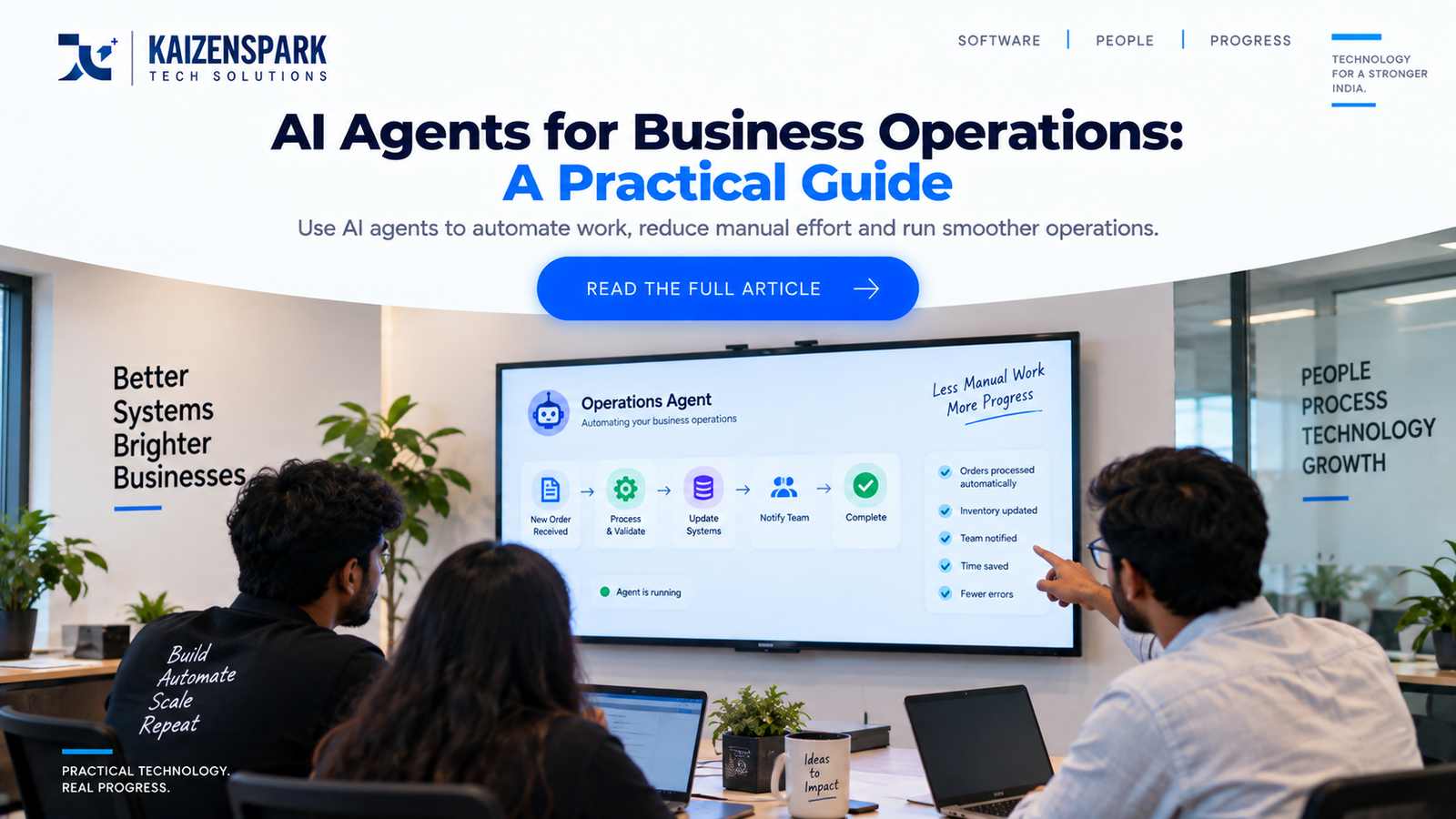
The National Institute of Standards and Technology defines agentic AI as systems that "function as autonomous agents capable of independently making decisions, learning from interactions, and adapting to changing environments," exhibiting "independent reasoning, goal-driven behavior, and the ability to interact dynamically with users, systems, and real-world scenarios." (NIST)
That is a meaningfully different thing from a chatbot that answers one question at a time, and a meaningfully different thing from robotic process automation that follows a fixed rule until something breaks it. An agent plans, uses tools, checks its own progress, and adapts across multiple steps toward a goal.
Almost nobody selling you one is building to that definition. This guide exists to help you tell the difference, and to summarise — plainly, with sources — what currently works, what doesn't, and how to run a pilot that tells you the truth.
The state of the market, honestly
Gartner predicts that over 40% of agentic AI projects will be cancelled by the end of 2027, citing escalating costs, unclear business value and inadequate risk controls. In the same research, Gartner names "agent washing" — the rebranding of existing chatbots, assistants and RPA tools as agents without the underlying capability — and has estimated that of the thousands of vendors now claiming agentic capability, only a small fraction have built something that qualifies. (Gartner, June 2025)
Deloitte's 2026 survey of 3,235 business and IT leaders found only 21% report a mature governance model for agentic AI — meaning roughly four in five are scaling systems faster than the guardrails around them. (Deloitte)
None of this means agents don't work. It means the category is young, badly policed, and full of relabelled older technology. Both things are true at once, and a good buyer holds both.
Where the evidence says agents actually work
The strongest peer-reviewed evidence remains a study of 5,179 customer support agents given access to a generative AI assistant: a 14% average increase in issues resolved per hour, and 34% for novice staff, with minimal effect on the most experienced. (Brynjolfsson, Li & Raymond, Quarterly Journal of Economics, 2025) This remains the most rigorous large-sample evidence available for AI in customer service — independent replication at this scale has not yet appeared elsewhere in the literature, and a post that pretended otherwise would be doing exactly what it accuses vendors of doing.
In government, the UK's cross-departmental AI coding assistant trial — over 1,000 staff across 50 departments — found engineers saved the equivalent of 28 working days a year. It also found that only 15% of AI-generated code was used without any edits, which is the honest part of the same result. (GOV.UK)
Gartner's most recent customer service survey found that AI spending by service leaders rose 38% while overall service budgets rose just 2% — a real reallocation, not a marginal experiment. (Gartner, August 2026)
Where it does not
McKinsey's 2025 State of AI survey found that among its narrowly defined "high performers" — organisations attributing more than 5% of EBIT to AI, about 6% of the sample — 55% had fundamentally redesigned their workflows around AI, versus 20% of everyone else. (McKinsey) That gap, not the model, is what usually separates a working deployment from an expensive pilot.
An agent bolted onto an unchanged process does not remove the process. It adds a layer on top of it, and the organisation now pays for both.
How to tell a real agent from a rebrand
Ask what the system does when it is uncertain. A genuine agent architecture has a defined answer — escalate, ask a clarifying question, or stop — because uncertainty handling is a designed feature, not an afterthought. A relabelled chatbot or RPA script usually has no coherent answer to this question, because it was never built to have one.
Ask whether the system uses tools and adapts its plan, or follows one fixed script with variables. The second is automation, which is valuable and much cheaper, but it is not an agent, and paying agent prices for RPA is how "agent washing" costs money.
Ask for a failure story. Anyone who has deployed agents at real scale has one, and can describe exactly where the system went wrong and what was changed afterward.
What this guide links to
This is the hub for our AI & Automation coverage. Related reading:
- What an AI agent actually is, and what most vendors sell you instead
- AI agents vs RPA vs chatbots: what the difference costs you
- How to run an AI pilot that survives contact with production
- Customer service automation: what the peer-reviewed data shows
- Where AI automation pays for small and mid-sized businesses
If you are evaluating an agent deployment and want the claims tested before you commit budget, that is a conversation we are glad to have.
Kaizen Spark Tech designs and delivers software, AI, automation and digital infrastructure for businesses and institutions. Every statistic here is linked to its original published source.